
A Self Help Group (SHG) is a small voluntary association of individuals, usually women from similar socio-economic backgrounds, who come together to save money regularly and support each other through small loans and collective activities. SHGs have become one of the most successful tools for financial inclusion, women’s empowerment, and rural development in India.
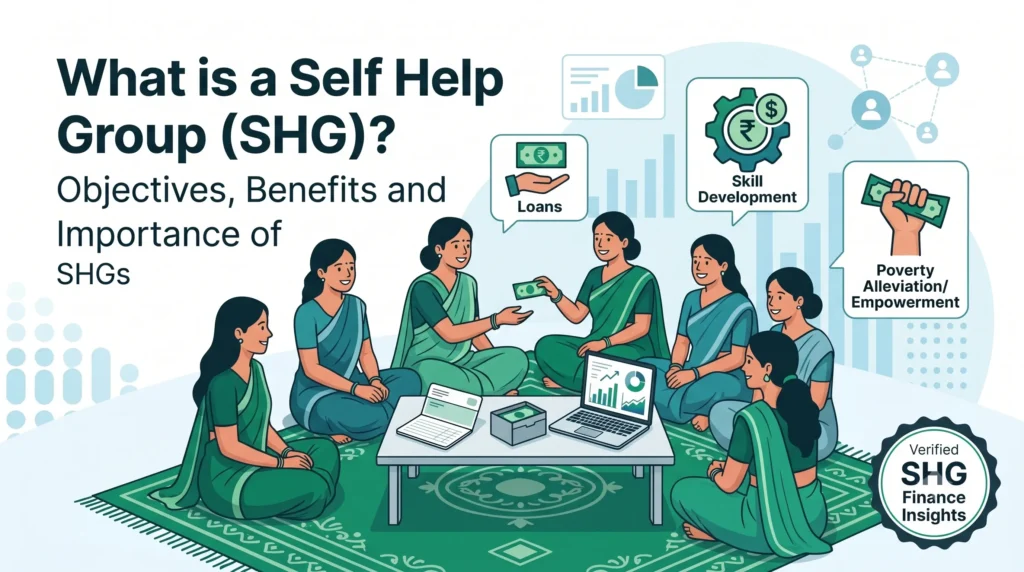
The SHG movement has transformed millions of lives by providing access to savings, credit, skill development, and livelihood opportunities. Today, SHGs play a crucial role in poverty reduction and community development under various government programs such as the Deendayal Antyodaya Yojana – National Rural Livelihoods Mission (DAY-NRLM).
What is a Self Help Group (SHG)?
A SHG is generally a group of 10 to 20 members who voluntarily come together to improve their financial and social conditions. Members save a fixed amount regularly and create a common fund that can be used to provide loans to group members in need.
SHGs promote mutual trust, collective decision-making, financial discipline, and self-reliance among members. Most SHGs in India consist of women because women’s groups have demonstrated higher repayment rates and stronger community participation.
Key Characteristics of SHGs
- Small group of members with similar backgrounds
- Regular savings by all members
- Internal lending from group savings
- Democratic decision-making
- Regular meetings and record maintenance
- Collective responsibility and accountability
- Financial inclusion and empowerment
History of SHGs in India
The SHG movement gained momentum in India during the 1980s and 1990s. The National Bank for Agriculture and Rural Development (NABARD) introduced the SHG-Bank Linkage Programme (SBLP) in 1992 to connect SHGs with formal banking institutions.
Over the years, SHGs became a major component of rural development programs and are now widely supported under DAY-NRLM, state rural livelihood missions, and various government schemes.
Objectives of Self Help Groups (SHGs)
The primary objective of SHGs is to improve the economic and social status of members through collective action and financial inclusion.
1. Promote Savings Habit
One of the main objectives of SHGs is to encourage members to save regularly. Even small savings can accumulate into a significant fund that benefits all members.
2. Provide Easy Access to Credit
SHGs provide small loans to members without the complicated procedures often associated with traditional banking systems.
3. Reduce Dependence on Moneylenders
Many rural families depend on informal moneylenders who charge high interest rates. SHGs offer affordable credit alternatives.
4. Empower Women
Women’s SHGs help members gain confidence, leadership skills, and financial independence while increasing participation in decision-making processes.
5. Improve Livelihood Opportunities
SHGs support income-generating activities such as agriculture, livestock farming, handicrafts, tailoring, food processing, and small businesses.
6. Strengthen Community Development
SHGs encourage collective action to address social issues, improve local infrastructure, and support community welfare initiatives.
7. Promote Financial Literacy
Members learn about savings, loans, budgeting, bookkeeping, and responsible financial management.
Benefits of Self Help Groups (SHGs)
SHGs provide numerous economic, social, and developmental benefits to their members and communities.
1. Financial Inclusion
SHGs help individuals access formal banking services, savings accounts, insurance, and credit facilities.
2. Easy and Affordable Loans
Members can obtain loans quickly for emergencies, education, healthcare, agriculture, housing, and business activities.
3. Higher Savings Culture
Regular savings improve financial security and help families prepare for future needs.
4. Women’s Empowerment
Women gain confidence, leadership abilities, and greater participation in household and community decisions.
5. Poverty Reduction
Access to credit and livelihood opportunities helps families increase income and improve living standards.
6. Social Support Network
Members support each other during personal, financial, and social challenges.
7. Improved Credit Discipline
Regular savings and timely loan repayments develop financial responsibility among members.
8. Employment Generation
SHGs encourage entrepreneurship and create self-employment opportunities in rural areas.
9. Better Access to Government Schemes
SHGs often serve as channels for implementing government programs, subsidies, grants, and livelihood initiatives.
10. Community Development
SHGs contribute to education, sanitation, health awareness, environmental protection, and social welfare activities.
How Does an SHG Work?
The functioning of an SHG typically involves the following steps:
Step 1: Formation of the Group
A small group of individuals voluntarily forms an SHG.
Step 2: Regular Savings
Members contribute a fixed amount regularly, usually weekly or monthly.
Step 3: Creation of Group Fund
The collected savings form a common group fund.
Step 4: Internal Lending
Members can borrow from the group fund based on agreed rules and repayment schedules.
Step 5: Bank Linkage
After demonstrating good financial discipline, SHGs can access larger loans from banks.
Step 6: Loan Repayment
Members repay loans with interest, helping the group fund grow over time.
Role of SHGs in Rural Development
SHGs have become powerful instruments for rural transformation by:
- Reducing poverty
- Promoting entrepreneurship
- Encouraging savings
- Enhancing financial literacy
- Supporting women empowerment
- Creating livelihood opportunities
- Improving social development
They contribute significantly to sustainable community development and economic growth.
Common Challenges Faced by SHGs
Despite their success, SHGs may face certain challenges:
- Irregular savings by members
- Loan defaults
- Lack of financial literacy
- Poor record keeping
- Limited market access
- Leadership issues
- Insufficient training
Proper training, monitoring, and support can help overcome these challenges.
Importance of Loan Repayment in SHGs
Timely loan repayment is essential for maintaining the financial health of an SHG. Consistent repayments improve the group’s creditworthiness and enable access to larger bank loans in the future.
Using tools such as an EMI repayment calculator helps SHGs plan repayments effectively and maintain financial discipline.
Conclusion
Self Help Groups (SHGs) have emerged as one of the most effective mechanisms for promoting financial inclusion, women’s empowerment, and rural development. By encouraging savings, providing affordable credit, and fostering collective action, SHGs help improve the economic and social well-being of millions of people.
As SHGs continue to grow and strengthen communities across India, they remain a powerful model for sustainable development, poverty reduction, and financial empowerment.
FAQs
1. What is the full form of SHG?
SHG stands for Self Help Group.
2. How many members are usually in an SHG?
Most SHGs consist of 10 to 20 members.
3. What is the main objective of an SHG?
The main objective is to promote savings, provide credit access, and improve the socio-economic status of members.
4. Can SHGs take loans from banks?
Yes. Eligible SHGs can access bank loans through the SHG-Bank Linkage Programme.
5. Why are SHGs important?
SHGs promote financial inclusion, women’s empowerment, livelihood development, and community welfare.